


Africa is the epicenter of mobile money globally.
Over $1.4 trillion was processed across the continent in 2025 — two-thirds of the worldwide mobile money total.
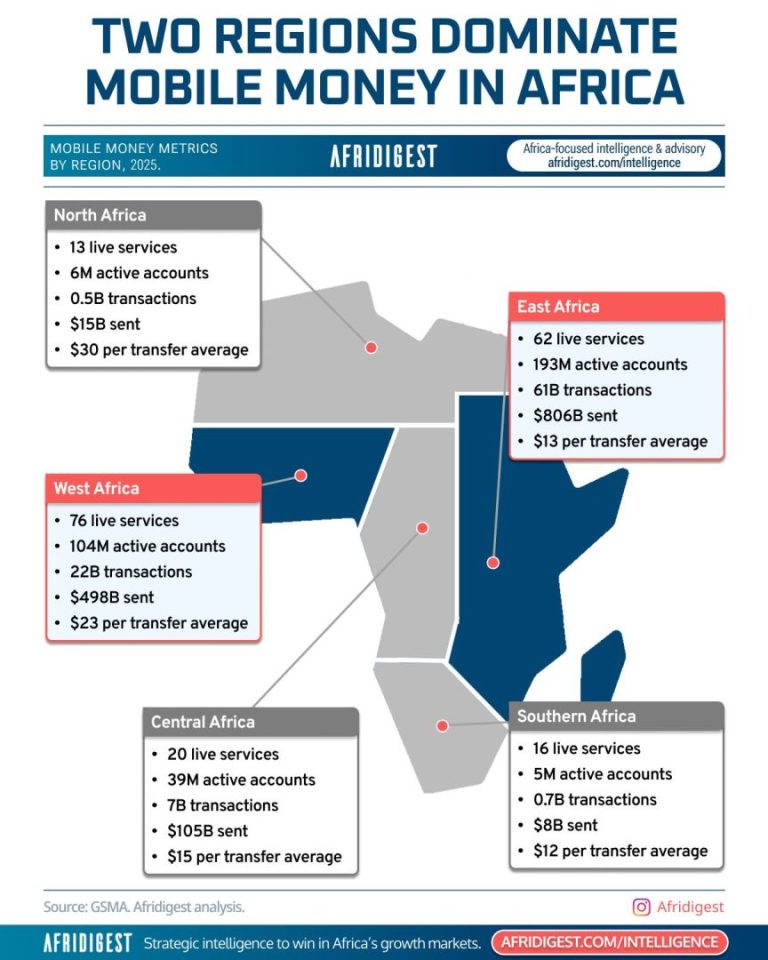
But ~92% of that was in just two regions: East & West Africa.
While Africa is indeed the mobile money continent, its sub-regions have fundamentally different profiles — in scale, structure, and use case.
Here’s an overview:
- East Africa is the continent’s volume king: $800B+ processed, 61 billion transactions, but just $13 sent on average → mobile money as everyday infrastructure
- West Africa is the services leader: 76 live services, ~$500B processed → the most competitive market on the continent
- North Africa moves money differently: only $15B processed in total, but the continent’s highest average value per transaction → mobile money as niche product for high-value, less-frequent transfers
- Central Africa is the emerging market’s emerging market: $105B processed with strong growth rates, infrastructure being laid, white space opportunity
- Southern Africa is a traditional banking market: Africa’s most developed banking sector — particularly in South Africa — keeps mobile money adoption low ($8B processed, just 5 million active accounts) despite relative wealth
But even within regions there’s significant diversity.
Ghana 🇬🇭, for example, is often cited as West Africa’s leading mobile money market — with high per capita usage, a deep telco-led ecosystem, plus the #1 ranked mobile money regulatory environment in the world per the GSMA.
Nigeria 🇳🇬, on the other hand, has historically been a mobile money laggard, but is now catching up fast — mobile money transaction volumes are up over 1,500% since 2021, driven by non-telco platforms like OPay, PalmPay, and Paga.
The lesson: there’s no such thing as an ‘Africa mobile money strategy.’
Market characteristics matter, and a ground-level understanding can mean the difference between significant ROI and wasted effort.
Socrates advised: ‘know thyself.’
But on the continent, as elsewhere: know thy market — and thy customer.
Everything else follows.
Decision-makers across the continent and the world trust Afridigest for Africa-focused intelligence & advisory → Afridigest Intelligence
Sign up here to receive the Afridigest newsletter in your inbox.



Share: